
Archives
How to perform CPR and use an AED in time of Covid?
In this article we will focus on Out of Hospital CPR and AED procedures for Lay Rescuers who are untrained or are trained for Basic Life Support, based on the AHA, ERC and PHA guidelines.
All guidelines currently focus on a safe procedure and recommend focusing on Hand-Only CPR for Laymen rescuers
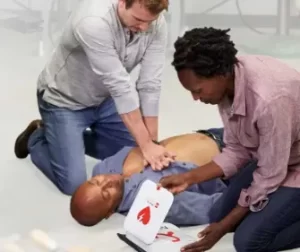
What is CPR?Cardio-Pulmonary Resuscitation, generally called CPR, is an emergency procedure used to manually pump blood from the heart and to supply oxygen to the brain and other organs especially when an individual stops breathing or with abnormal breath i.e. cardiac arrest which may be caused by a blockage in coronary artery, profuse blood loss, shock, blockage of the airway among others.
What is the purpose of CPR?
To manually force the person’s heart to pump blood from the heart to all the vital organs inside the victim who suffers Sudden Cardiac Arrest and keep that person ‘artificially alive’ by pumping oxygenated blood through the body to all the vital organs (brains, heart, liver, kidneys etc.)
What steps do you follow if someone suffers Cardiac Arrest?
Check for Danger
Ensure the environment is safe for you before rendering help so you don’t put your own life in danger in the process.
Protect yourself from direct contact with body fluid, wear your gloves, face mask, and other protective equipment if available since the covid-19 physical distancing protocol is not achievable.
Check for Response
Impairment to the brain’s normal activities following a cardiac arrest episode affects unconsciousness. Responders are to observe if the person is aware of his environment; this can be achieved using the AVPU scale.
In all situations make sure to cover yourself with a N95 Mask.
The AVPU scale
A – Alert
Is the person aware of your presence?V – Voice
Can he respond or hear your voice as you call and speak to him?P – Pain
The back of the hand is a very sensitive part, slowly and gently pinch it to assess the casualty for pain and response to stimulus.U – Unresponsive
If all the above fail, then the casualty is said to be in an unresponsive state and needs immediate help.Check for Breathing
Check if the SCA victim is breathing by looking from a safe distance. Look at the person’s chest and stomach for signs of movement. Look for the rising and falling of the chest and stomach.
All above assessments should not take longer than 10 seconds.
Call for Help
Call for help while simultaneously checking for breath to maximize time, use your phone’s inbuilt speaker to communicate so you can multitask and follow instructions from emergency service.
And if you are with someone else, tell the person to make the phone call to the emergency hotline of the nearest hospital or local emergency number (always have these numbers preprogrammed in your cellphone). If a third person is available, appoint him/her to get the AED while you proceed with CPR.
How to perform Safe CPR as a Lay Rescuer?
Ensure you are well protected; wear a proper face mask for yourself and use another face mask to cover the mouth and nose of the victim to prevent exposure to aerosols that may be generated during chest compressions.
As an untrained responder (Lay Rescuer) without wasting much time, commence CPR without rescue breaths, once you have established that the individual has no breath, or even with abnormal breath (abnormal breath such as occasional gasp is considered as no breath).
This is also called ‘compression-only’ CPR and is commonly used in these Covid times to give the lay rescuer a safer rescue procedure. This procedure can be done by everyone, trained and untrained responders can still provide aid for individuals who experience sudden cardiac arrest before the interventions of the professionals.
Several studies have shown that adults with sudden cardiac arrest usually have oxygen in their system after the arrest. And for this reason, all that is most important is for their heart to pump out blood that would carry the oxygen to the brain and other organs which is achievable through effective chest compression.
In addition, due to the transmission mechanism of covid-19 and other infectious diseases, compression-only CPR has become more popular, and an effective and safer way to give CPR to anyone with little or no risk of contracting the disease.
HOW TO PERFORM HANDS-ONLY CPR
- Survey the environment to see that it is safe for you.
- Call your local emergency line or someone who could help,
- Wear your face mask, and wear another for the victim if available. If none is, find something to cover the mouth and nose of the casualty to reduce the escape of aerosols that may carry infection as you compress (use a cloth or cover face with the shirt of the victim).
- Then, put the heel of your dominant hand over the breastbone at the center of the chest
- Put the second hand over the dominant one, then interlock the fingers and ensure elbows are locked.
- Compress the chest hard and fast to the beat of the Bee Gees’ disco song “Stayin’ Alive.” The music is about 103 beats per minute which is almost equal to the minimum rate you should compress (compression rate is between 100-120 compression per minute).
The compression depth is about 4-5 cm (2 inches) which is about 1/3 of the chest cavity.
How to perform CPR with rescue breaths as a trained responder?
According to the AHA 2010 and ERC CPR Guidelines, it includes chest compressions and 2 artificial ventilations in the ratio of 30:2 (i.e 30 chest compressions to 2 artificial ventilation)
Ventilation can be delivered through the mouth to mouth, mouth to mask, and bag valve mask ventilation method. But as important as ventilation is, it is not considered as necessary as chest compression and can be discarded if you are not comfortable giving it or when it is not safe.
The covid-19 pandemic has also made it unsafe to deliver mouth-to-mouth ventilation because of the risk of getting infected; this has made HANDS ONLY CPR for first aiders and responders who would like to help strangers without known medical conditions become more popular.
Nonetheless, artificial ventilation can be performed on people in your household since you cohabit. It is hard and impossible for this category to follow the covid-19 protocol already.
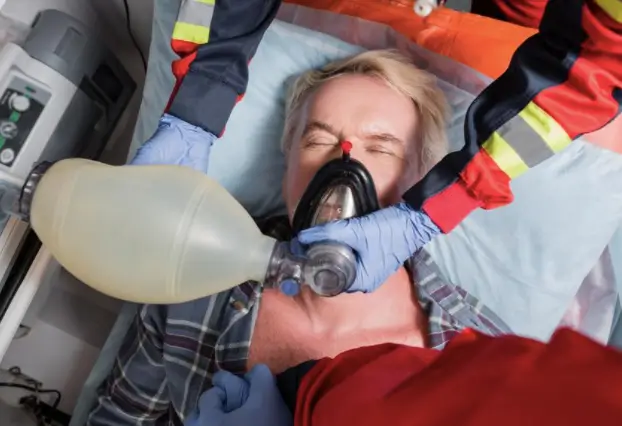
The Bag-Valve-Mask (BVM) Ventilation Method
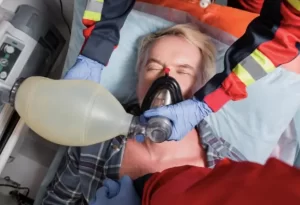 For this procedure you need 3 trained rescuers; one that does CPR, one rescuer that folds the CPR mask and one that operates the Bag-Valve-Mask (BVM). The BVM employs the use of a respiratory kit made up of a self-inflating bag, a one-way valve, and a mask to seal the mouth and nose of the casualty.
With this technique, one can deliver high-quality oxygen that is better and safer than the one produced from the mouth.As good as it is, it requires adequate and consistent practice to deliver sufficient amount of oxygen that’s required. In addition, it is usually applied when there is more than a responder available; one can help with the mask on the face while the other presses the bag for oxygen to be delivered.
How to use the AED?
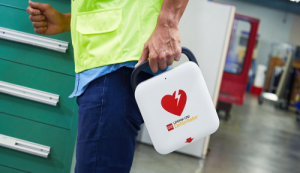
To increase the chances of survival, use the Automated External Defibrillator if available.
Due to some reasons, the electrical activity of the heart may get disorganised thereby resulting in cardiac arrest. Delivering quality electric shock to the already fibrillated heart is necessary and effective in restoring the hearts normal electrical activity and rhythm through the use of an AED
Step-by-step on how to use the AED
- Get the AED.
- Open the case, then switch it on.
- Open the AED Electrode pads.
- Remove the backing.
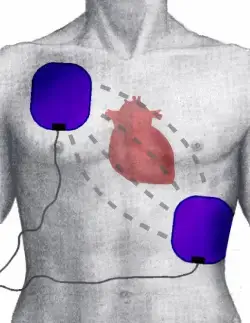
- Apply the two electrode pads*
- Apply the first pad above the breast on the upper right.
- Apply the second below the armpit on the lower left chest.
- Be sure that the electrodes are attached correctly and in good contact.
- Stop CPR and let the AED analyse the heart rhythm. Ensure no one is touching him at this point.
- When the AED prompts that you deliver Shock
- Ensure nobody is touching the person, then,
- Press and hold the “shock” button until the AED delivers the shock.
- Continue CPR for another 1.5 to 2 minutes, then repeat the AED sequence.
- Repeat procedures over again.
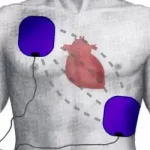
*Apply the two Electrode Pads
The Philippine Heart Association 5 C’s guidelines
In the Philippines, The Philippine Heart Association has clear guidelines on how to perform safe Lay Rescuer CPR in times of COVID for Out-of-Hospital Cardiac Arrests.
These guidelines are called 5 C’s for Lay CPR amidst COVID:
1. Check – on the victim from a safe distance
2. Call – quickly call for help
3. Cover – protect both rescuer with a proper face mask and victim with a face mask or cloth.
4. Compress – do hands-only CPR
5. Connect – go for early defibrillation with an AED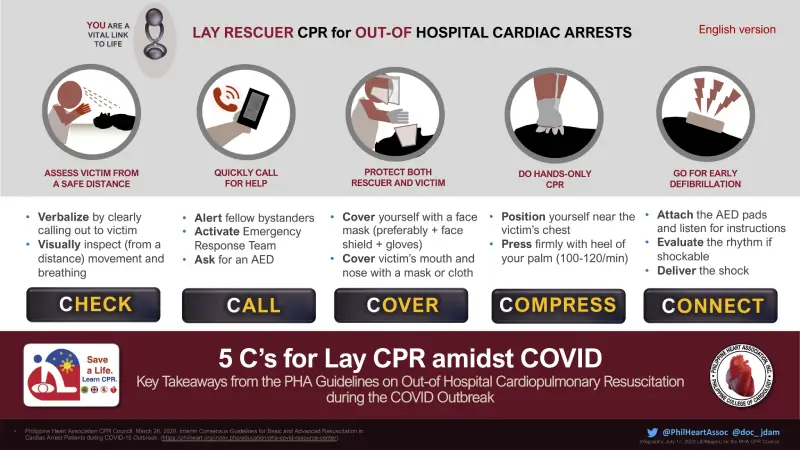
Source: Dr. Jose Donato Magno, @doc_jdam
Read more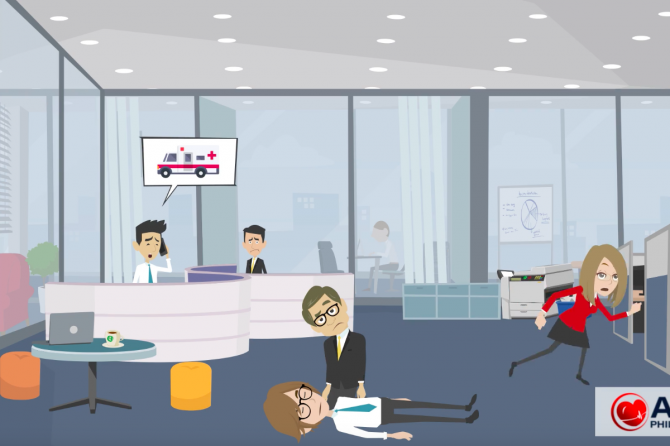
Save a Life: How to Help Someone With Cardiac Arrest?
You may ask yourself sometimes: How do I help a person who has Cardiac Arrest?It is very important to know what steps to take to give somebody who has Sudden Cardiac Arrest a chance of survival. Follow these steps and try to help to save a life. Are the surroundings Safe? First, see if youRead more
7 Simple Things to live a Happier and Healthier life!
We all care about our health and with the following methods you can check and control your Hearth Health using American Heart Association’s life’s Simple 7. Seven simple things that you can do to live a happier and healthier life! Get Active Living an active life is one of the most rewarding gifts that you canRead moreHow to respond to Sudden Cardiac Arrest (SCA)?
How to respond to Sudden Cardiac Arrest (SCA) is a question many of us don’t know about. This video will learn you what the appropriate actions one takes if they encounter somebody with Sudden Cardiac Arrest. Inquire today if your company needs an Automated External Defibrillator: 02-75854765 / 0917-8098588. Share this video with your friends
Read more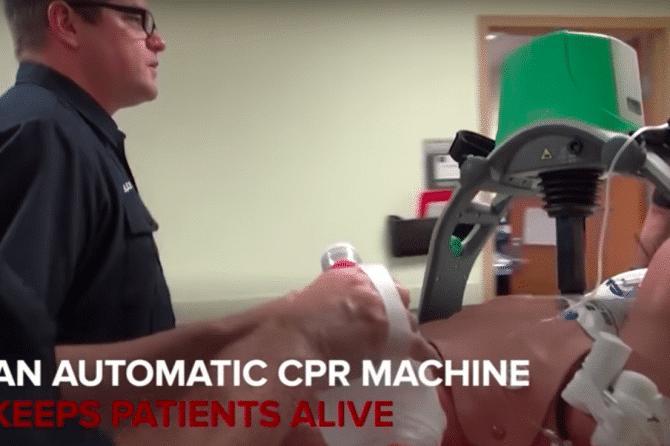
Higher SCA Survival Rate of 40 percent with New Study
A new protocol that proves to have higher SCA survival, tested by the Ohio State University Wexner Medical Center has proven to increase higher cardiac arrest survival rate with 40%.
Before adding an Automated CPR device (such as ZOLL Autopulse or LUCAS 3) to the patient before going to the hospital, their EMS provider informs the hospital before arrival that three shocks haven’t been successful to restart the heart. The patient then will undergo ECPR which stands for extracorporeal cardiopulmonary resuscitation, where the patient’s blood is passed through a device that oxygenates the blood supply in combination with getting automatic CPR.
This way the Sudden Cardiac Victim can skip the Emergency room and go directly to the heart catheterization department and get connected to the ECMO machine to detect blockage of the arteritis. It has increased the sca survival rate by up to 40%.
If this protocol gives a higher SCA Survival rate, we think this should be used worldwide!
Read moreCOLUMBUS, Ohio — A new protocol being tested by a university medical center is increasing cardiac arrest survival rates from zero to around 40 percent.
The Ohio State University Wexner Medical Center is teaming up with the Columbus Division of fire to test the extracorporeal cardiopulmonary resuscitation (ECPR) protocol, which is initiated if EMS providers are not able to restore a normal rhythm after shocking the heart three times.
It’s astounding that patients are able to fully recover and walk out of the hospital when they would have been pronounced dead in the field before this protocol was in place,” Dr. K. Dean Boudoulas said.
Under the protocol, EMS providers alert the hospital before connecting the patient to an automatic CPR device to preserve brain and organ function while en route to the hospital.
When the patient arrives, they can bypass the emergency room and go straight to the heart catheterization lab to be connected to an ECMO machine.
This allows the heart and lungs to rest while doctors perform a heart catheterization to find the problem, which is usually a blocked artery,” Dr. Bryan Whitson said.
Officials hope to make this protocol the standard for treating cardiac arrest patients.
Explanation on what an AED does
In this video ZOLL clearly explains what the ZOLL AED Plus does for the lay rescuer. Take a good look and see how easy it is to use an AED in Sudden Cardiac Arrest situations.
Read moreZOLL AED 3 BLS now in the Philippines
The Zoll AED 3 The latest device from ZOLL. The ZOLL AED 3 has been programmed in accordance with the latest CPR guidelines. The rescuer is helped through the CPR process by means of resuscitation feedback. This is done not only by means of the CPR Uni-Padz, but also by the instructions on the color
Read moreThe 5 Components of High Quality CPR
The following article is written by David Grovdahl, MS, NRP is an EMS director and advocate for rural EMS systems. He has been a paramedic for 18 years and lectures frequently on topics ranging from data analysis to system design and the integration of technology in rural areas.
The 5 Components of High Quality CPRNot that long ago, professional rescuers were taught to push hard and fast when treating victims of cardiac arrest. That’s all you needed to ensure you were doing good chest compressions, or so you were taught. The 2015 American Heart Association (AHA) and European Resuscitation Council (ERC) Guidelines continue to raise the bar on what’s required to provide life-saving CPR. High-quality CPR Defined In the 2015 Guidelines, the AHA describes high-quality CPR as the combined impact of 5 factors:
1. • Depth: 2–2.4 inches (5–6 centimeters)
2. • Compression rate: 100–120/minute
3. • Recoil: Allow for full recoil after each compression. No leaning.
4. • Minimize pauses. Get the chest compression fraction (CCF), the percentage of time CPR is being delivered, as high as possible, with a target of at least 60%. It may be reasonable with a sufficient number of rescuers to achieve a CCF greater than 80%.
5. • Ventilation: 2 breaths after 30 compressions without an advanced airway; 1 breath every 6 seconds with an advanced airway.These metrics represent our best description of the type of CPR that is likely to result in a good outcome for patients. Each factor contributes to patient outcomes and needs to be monitored, recorded, and reviewed for continuous quality improvement.
One of the significant changes in the 2015 Guidelines was establishing an upper limit of 2.4 inches for compression depth and more specific guidance on rate: 100 to 120 compressions per minute, compared with >100 in the 2010 Guidelines.
Read moreMeet the PlusTrac AED Management Program
What is PlusTrac™ and how can it help you? PlusTrac™ is an AED program management system that allows you to manage the AED(s) in your company. To save a victim of a cardiac arrest it requires an AED that is ready to deliver a life-saving solution, but an Automated External Defibrillator alone is not enough.
Read more

© 2025 AED Philippines. All rights reserved.